Amazon DRM Changes 2026: What Authors and Readers Need to Know
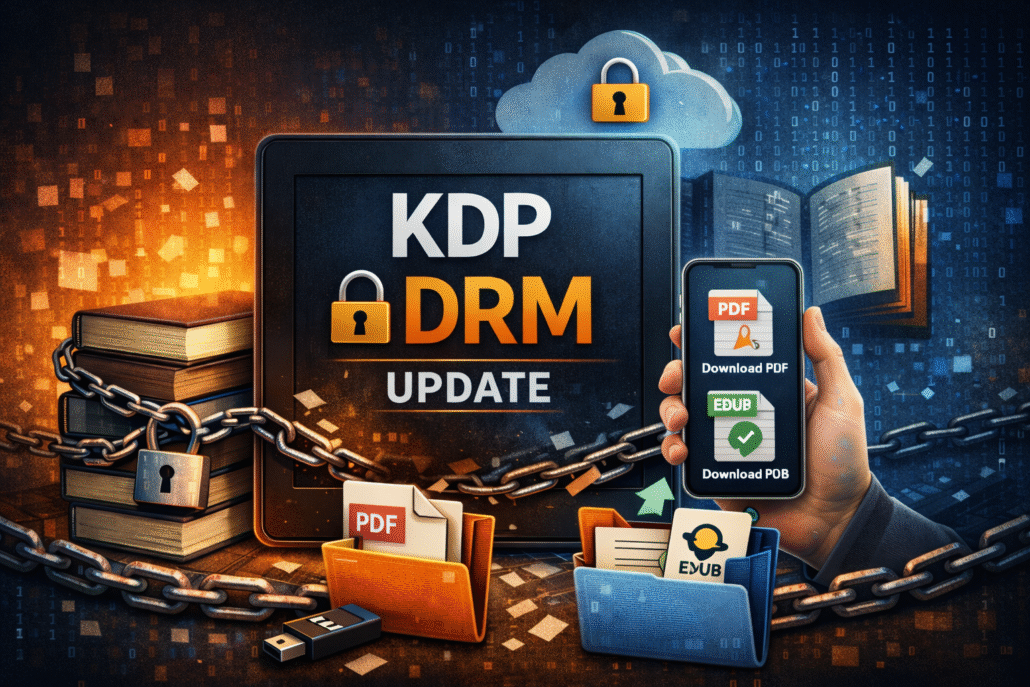
Amazon is making yet another change: from 20th January 2026 some Kindle books without DRM will be downloadable as EPUBs and PDFs.
Worried this could affect your books, your readers, or your sales? Not sure what to do for the best? Confused about what DRM is? Let’s have a look at this.
We’ll look at what it means as a reader and what it means for you as an author. If you are a member of the Idea to Author Club, there will be an opportunity for us to discuss this further within our community.
DRM stands for Digital Rights Management, and from the 20th of January 2026 people who buy your eBook on Amazon will be able to download it as an ePub or a PDF file.
What is DRM and why was it put in place? Well, it is primarily to prevent your ebook being shared or pirated, and it should limit unauthorised access and copying. It is a bit like a padlock around your ebook. But locks can be picked if you have the right tools, so I think in reality, it doesn’t stop piracy and unauthorised sharing completely. And I know from the past, if an ebook has DRM enabled, then it has sometimes caused problems for the readers, and they’ve not been able to access the ebook properly or read it, which obviously is not a good thing.
With all the ebooks that I’ve created and published over the years, I’ve always set them to DRM free for my clients. Now with this new rule, if your ebook was set to DRM free, then it won’t automatically mean that your book will become available as an ePub or a PDF. You will need to opt in or opt out.
Basically, what it means is that if DRM is applied, then readers cannot download your book as an ePub or a PDF. They cannot transfer your book to other non-Kindle devices that they might have, so they won’t be able to read it on all e readers.
Whereas, if it’s DRM free, then it can be transferred to and read on other devices, and it can be downloaded as an ePub or a PDF.
But whichever way it goes, your royalties are not affected, because that’s a separate issue because they’ve still bought your book. From a reader’s point of view, it’s giving them more control over something that they have already purchased.
This new rule does not apply to book ebooks that are downloaded as part of a Kindle Unlimited subscription. Regardless of whether they are DRM free or not, subscribers will not be able to download them as ePubs or PDF.
If you want to know how to check whether your ebook is DRM enabled or not, or you want to change the settings, then watch a short video here to show you how to do that.
So, what is the consensus of opinion on this new change? Well, from a reader’s point of view, it can be seen as a positive step, because more people have multiple devices now.
It’s a bit like when you buy an MP3, for instance, you’re actually buying it. You can put it on multiple devices. It belongs to you. And if you think about paperbacks, you buy the paperback. It belongs to you.
But with a Kindle, you are tied into one particular platform. So, you are tied into Amazon. You can’t read it on any other platform. And you are reliant on that platform to give you continued access.
The question of piracy, I think, isn’t such a huge one, maybe because I think people could do it anyway, if they really wanted to. A greater worry to authors is probably that by downloading an ePub or PDF, it makes it much easier to share with readers who haven’t bought it (just like a paperback can be passed on to a friend to read).
I am playing devil’s advocate a little here, but I would welcome your thoughts and comments from a reader and an author perspective.
One thing I have noticed over the years is that not all ePubs are created equal. Depending on how an ePub is produced, it may not display as well on other devices as it does on a Kindle. Even PDFs can be temperamental in how they display which may affect the overall reading experience.
So, the questions to ask yourself about your book are: Do I think loads of people are suddenly going to be sharing my book? Or are my readers going to increase because of greater accessibility?
Think about libraries and research or education institutions, surely for non-fiction books allowing these types of places to have a downloadable PDF would make it easier for them to include your work. And as they are well aware of copyright issues and accurate referencing then it could be another royalty stream and increase your readership.
There’s also the question of AI because obviously the AI must learn from something. So, I think there is a concern amongst some authors that it will make it easier for AI to use their books to learn and plagiarise it. But to be frank, I think that’s happening anyway, regardless of whether there are ePubs or PDF downloads. It just maybe makes everything a little bit easier, but from a reader’s point of view, it certainly is a step in the right direction as far as ownership and readability is concerned.
So overall, it seems that the opinions on this latest Amazon change are quite mixed with Indie and self-published authors being sceptical and worried about the piracy risk on the one hand, but then appreciating the extra choice that it will give their readers and potentially increase their readership as a result.
Readers may value this change, as it gives them more flexibility if they use other e readers.
But I think for any kind of long-term Kindle readers that are completely tied into Kindle, and that’s what they love, it’s not really going to make any difference to them.
What is your opinion on this?
What do you think about these changes as an author?
Does it worry you if you are an indie or a self-published author?
Are you going to change the DRM status of your ebooks?
As a reader, I would love to hear your opinion as well. Will this make any difference to you?




Leave a Reply
Want to join the discussion?Feel free to contribute!